| TL;DRYour stock just dropped. Issue your wire release first – then get a CEO video out within 12 to 24 hours. The video and the press release work together; one does not replace the other.Five video formats cover the full 72-hour window. Each serves a different audience at a different moment.Canadian IR video has specific legal requirements. A wire release – an official news distribution service like Newswire or Globe Newswire – must go out before any video containing material information.How your video looks and sounds tells investors something about how you run your organization.This article is for informational purposes only and does not constitute legal or securities compliance advice. |

Your Stock Just Dropped. Here Is What to Do in the Next 72 Hours.
You are not going to stop the market from moving. What you can control is whether your investors hear from you before they start filling the silence themselves.
Silence after a market shock does not read as calm. It reads as absence. Analysts start downgrading. Shareholders call the IR line. The message that takes hold is the one someone else wrote.
In March 2026, the TSX dropped nearly 500 points in a single day – driven by rising oil prices and geopolitical tensions in the Middle East that threatened global energy supply. The Bank of Canada held interest rates steady, signalling that no rate cut was coming to soften the blow. For IR directors at Canadian public companies, that kind of environment – falling markets, rising costs, no relief in sight – is exactly when how you communicate determines how much investor confidence you keep.
There is one rule before anything else: if your video contains new information that could affect your stock price, a news release through an official wire service must go out first. That is a legal requirement, not a guideline. The video and the news release work together – the news release fulfils the legal obligation, and the video does what a news release cannot: it puts a real person on screen.
This is a practical guide for IR directors and communications leads at TSX-listed and TSX Venture Exchange-listed companies across Canada. It covers the five video formats that matter most, the 72-hour window that shapes your investor narrative, what the law requires, and how to measure whether it worked.
The 72-Hour Window: Five Formats, Five Moments
The first three days after a market event are when the investor narrative gets written. Every format below has a specific job. Skipping one leaves a gap that someone else will fill.
| Window | Format | Audience | Goal |
| 0-24 hrs | CEO Direct Message | All shareholders | Presence + calm |
| 24-48 hrs | Strategy Explainer | Retail shareholders | Context + next steps |
| 48-72 hrs | Executive Roundtable | Institutional + analysts | Depth + alignment |
| Week 2+ | Operational Tour | Institutional investors | Proof of continuity |
| Week 2+ | Investor FAQ Video | All shareholders | Reduce IR inquiry load |
0-24 Hours: CEO Direct Message
Three to five minutes. Face to camera. No slides, no panel, no moderator.
Before the camera rolls, your news release is already out through an official wire service. Once that is done, the CEO video does the job the news release cannot: it shows a person. Acknowledge what is happening. Reaffirm your financial position and long-term plan. Commit to a fuller update within 48 hours. You are not trying to explain everything – you are trying to show up before your investors start wondering where you are.
This is the most important IR video you will ever produce. Everything else in the 72-hour window builds on getting this one right.
24-48 Hours: Strategy Explainer
Now you can go deeper. Walk your shareholders through your financial position, your risk exposure, and what you are actively doing. Keep it under ten minutes and use simple visuals – a one-page summary or a short timeline works well.
Investors are pressed for time and tend to skim long written updates. A focused video that gets to the point gets watched. This format is especially valuable for retail shareholders who are not on the analyst call – it closes the information gap before rumours take hold.
If you are a TSX Venture Exchange company, this is also the right place to address a new option available as of March 2026: the CSA SAR Pilot allows smaller venture issuers – those with revenue under $10 million CAD and at least one year of reporting history – to file financial reports every six months instead of every quarter. If your company is adopting this, use a video to explain why. Without any explanation, moving from quarterly to semi-annual reporting can look like you are becoming less open with shareholders, even if the change actually makes sense for your company size.
48-72 Hours: Executive Roundtable
A conversation between your CEO, CFO, and one other senior leader – typically your Chief Risk Officer – addressing the questions analysts and major shareholders are already asking. Use pre-submitted questions. You know what they are going to ask, so answer those directly rather than waiting for a live Q&A where off-script answers can become the headline.
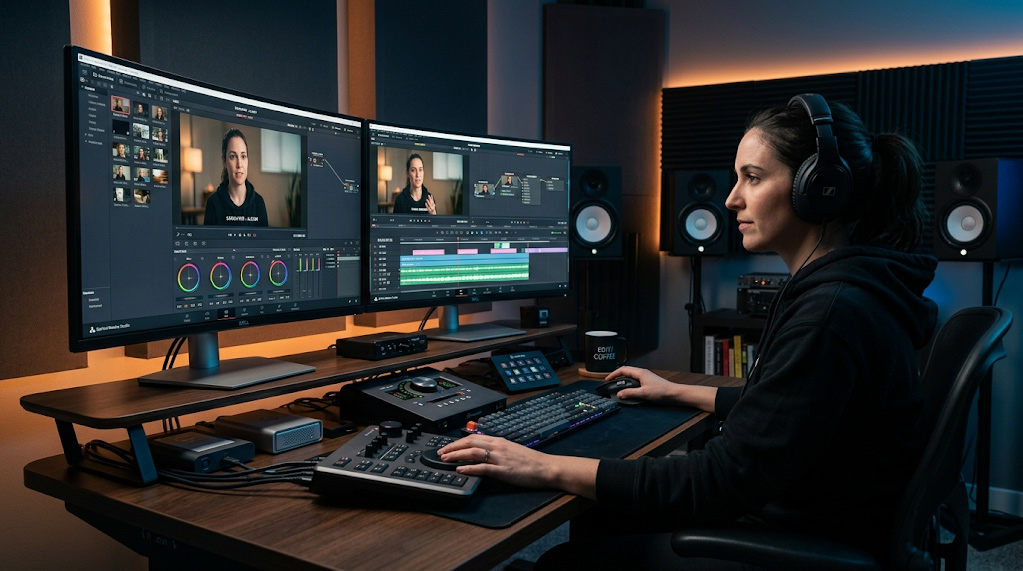
One thing worth knowing in 2026: investor videos get picked up and summarised by AI tools almost immediately after they go live. Those summaries get circulated to analysts and portfolio managers quickly. This means inconsistent language across your videos – say, your CEO describing liquidity one way and your CFO describing it another way – gets spotted and flagged. Prepare your answers in advance, agree on the specific words you will use for key topics, and make sure every member of the team is saying the same thing.
The roundtable format signals something beyond what is actually said: your senior team is aligned, available, and not hiding.

Week Two and Beyond: Operational Tour and FAQ Video
An operational tour is visual proof that the business is running – not a crisis video, but the opposite. A demonstration of normalcy.
An investor FAQ video handles the questions your IR line is still fielding two weeks later. It frees your team and gives retail investors somewhere to go instead of speculating. Both require planning in advance. Build them into your IR calendar before you need them.
How Your Video Looks Is Part of the Message
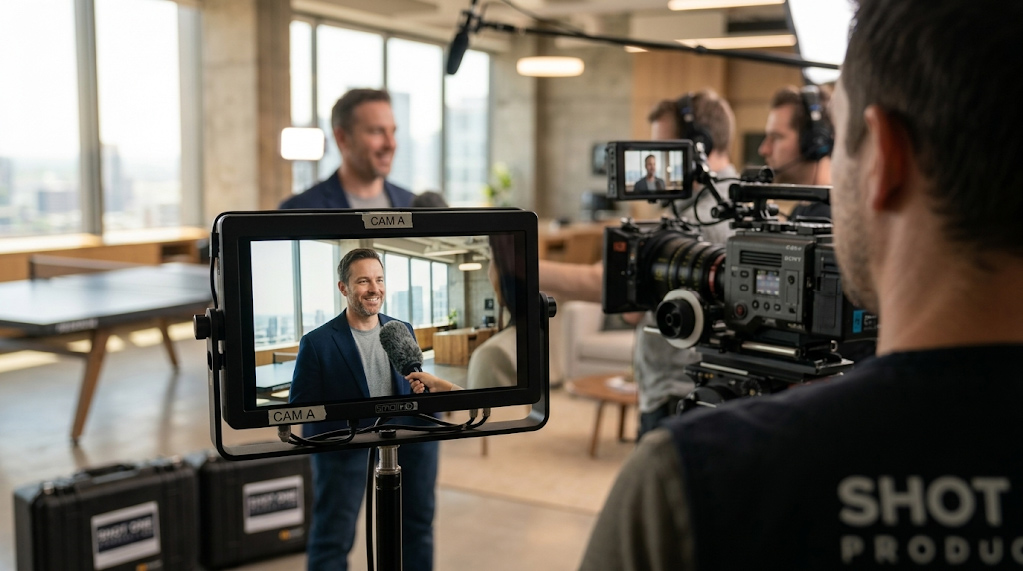
You do not need a film crew. But you do need to clear a basic bar – because a video that looks or sounds poor tells investors something about how your organization operates. Three things matter more than everything else:
- Sound. If viewers have to strain to hear the speaker, they stop watching. Use a clip-on or handheld microphone – not your laptop’s built-in mic. This matters beyond professionalism: AI tools now transcribe investor videos almost immediately after they are posted, and those transcripts get circulated to analysts. A poor audio recording produces errors in the transcript that end up being quoted as if they are what your executive actually said.
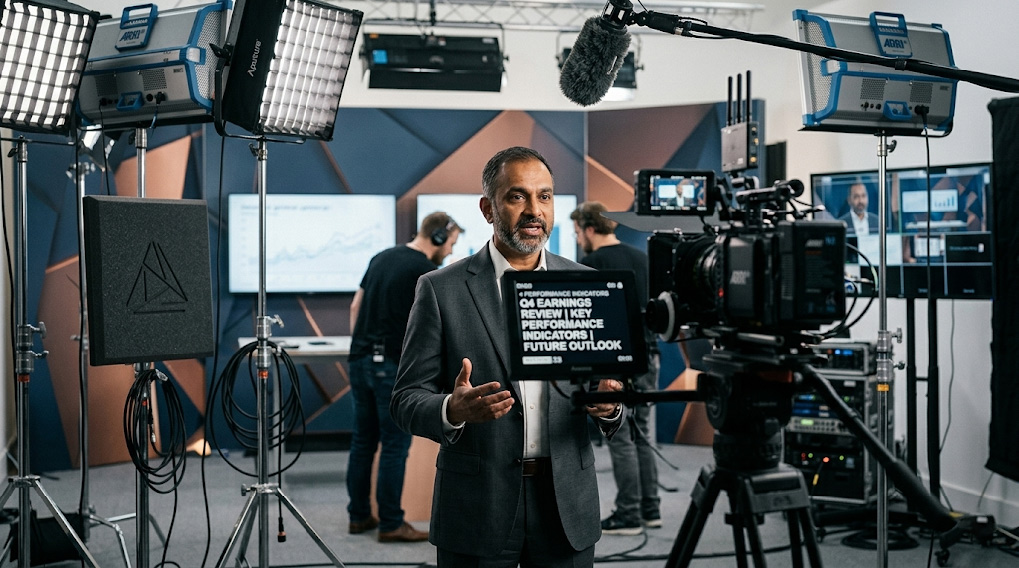
- Eye contact. An executive who is glancing down at notes reads as uncertain. A teleprompter – a screen that shows the script at eye level – keeps the delivery direct and natural. In a crisis, looking directly at the camera is the simplest way to signal that your leadership is composed.
- Lighting. A poorly lit executive looks fatigued or evasive on screen, even if neither is true. Proper studio lighting – light coming from multiple angles to remove harsh shadows – keeps the speaker looking clear, confident, and credible.
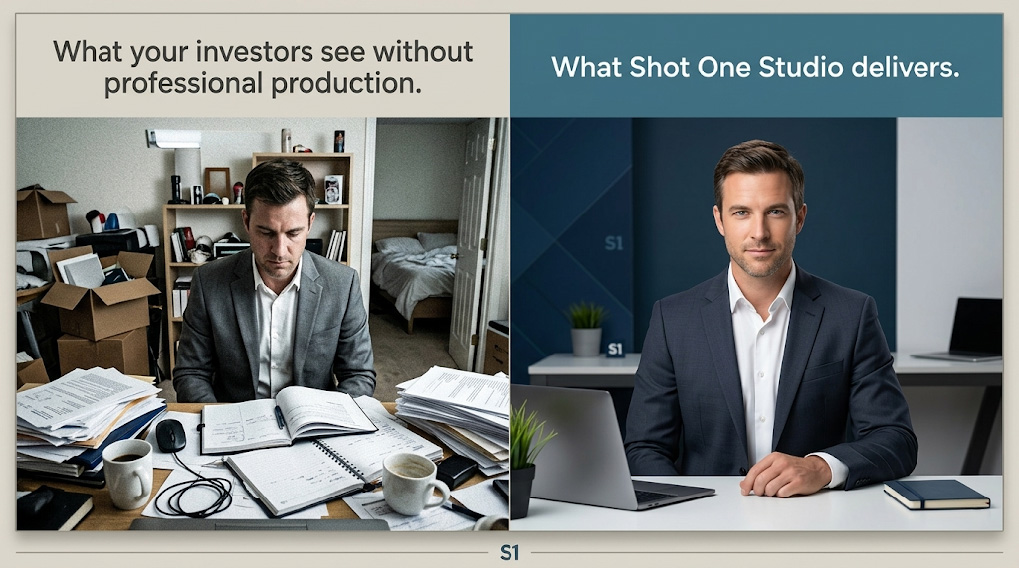
A video that looks or sounds rough does not just seem unprofessional. It plants a question in the viewer’s mind about whether your organization pays attention to detail. During a market shock, that is the last question you want anyone asking.
A Note on French-Language Content
If a meaningful portion of your shareholders are based in Quebec, French-language content is not a nice-to-have – it is a governance standard. Canada’s securities regulator for Quebec, the AMF, expects that all investors have equal access to information. During a market event, publishing a dual-language CEO message or adding French subtitles to your key videos shows that your organization takes all of its investors seriously – not just the ones reading in English.
What Canadian Law Requires
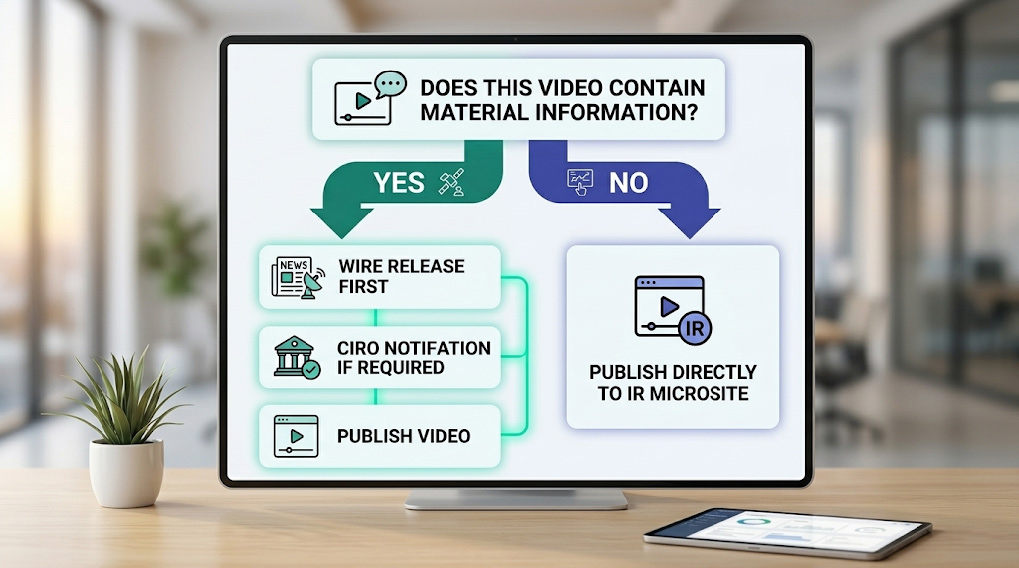
The rules are not complicated once you understand the core principle: if your video contains any new information that could move your stock price, a news release must go out first. Not at the same time. First. That is the law under Canadian securities regulations – not a suggestion.
Before the compliance table, two terms are worth knowing:
- A news release through a wire service means sending your announcement through an official distribution service – Newswire or Globe Newswire – that delivers it simultaneously to all investors and media at the same moment. This is what the law requires. Posting to your website or LinkedIn is not a substitute.
- SEDAR+ is Canada’s official system where public companies file their regulatory documents. It only accepts PDF documents – you cannot upload a video file to SEDAR+. Your video lives on your website; the PDF news release filed on SEDAR+ is the official legal record.
| Rule | What It Means | What to Do |
| News release via wire service(NP 51-201) | Any new information that could affect your stock price must reach all investors at exactly the same time | Send through Newswire or Globe Newswire before the video goes live – not after, not alongside a portal post |
| No video before the wire(TSX Policy 3.3) | You cannot publish a video containing material information before the wire release goes out – even by a few minutes | Treat the wire release as the starting gun. Nothing goes live until it fires. |
| Forward-looking statements | Any statement about future performance – growth targets, guidance, projections – requires a clear disclaimer | State the disclaimer out loud in the video and display it on screen. Every time. |
| SEDAR+ filing | SEDAR+ accepts PDF documents only. You cannot upload a video file. The PDF news release is the official legal record. | File a PDF news release on SEDAR+. Link to the video from that release. The video is supplementary. |
| Dealer involvement(CIRO) | If a registered investment dealer is helping produce or distribute your video, that video must be reviewed and approved by a designated supervisor before it goes out | Check with your compliance team before involving a dealer in any investor-facing video |
| Material change | If your video announces a significant change to the business, a formal report must be filed with your securities regulator within 10 business days | Talk to legal before you publish. If in doubt, file. |
For every video, the same five steps apply:
- Have your legal or compliance team review the script before recording – not after.
- Send the wire release before or at the same moment the video goes live. Not to one group first and everyone else later.
- Add a spoken and on-screen disclaimer for any statement about future performance. Every time, no exceptions.
- Clear the recording space of any confidential materials before the camera rolls.
- If the video triggers a material change, co-ordinate the SEDAR+ PDF filing with your legal team before publishing.
| One thing to watch: the ‘portal first’ mistakeSome IR teams publish material information to a password-protected investor portal before the wire release goes out, assuming that because access is restricted, it counts as controlled disclosure. It does not. Canadian securities law requires that material information reach all investors at exactly the same time – and a private portal does not satisfy that requirement. Use your portal for background context and non-material updates. Material news goes to the wire first. |
Which provincial regulator applies to you depends on where your company is based and where your investors are. Ontario, British Columbia, Alberta, and Quebec each have their own securities regulator. Your legal counsel will know which ones apply – the important thing is to have that conversation before a market event, not while one is happening.
Where to Publish and What to Measure
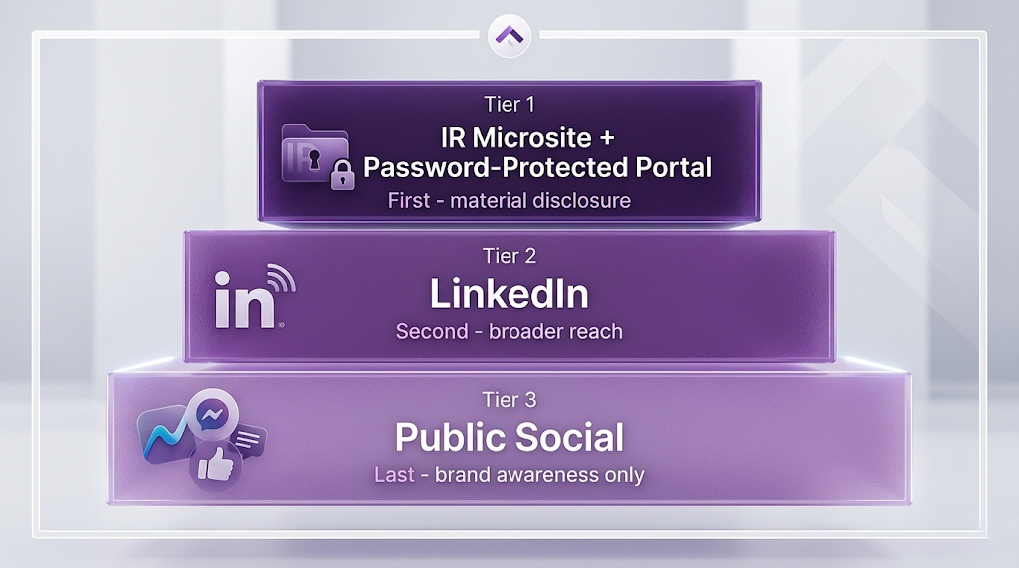
Publish in This Order
- Wire release first – every time the video contains material information. Everything else depends on this step being done.
- Your IR microsite and investor portal second. This is where institutional investors and analysts look for official content, and it gives you real engagement data – who watched, for how long, and from which organization. Note: if the video contains material information, the wire release must already be out before you post here.
- LinkedIn third. Institutional investors use social media as part of their research process – native video on LinkedIn reaches significantly more people than a link to an external page. But LinkedIn alone does not satisfy your legal disclosure obligation.
- Public social channels last. Retail investors are increasingly on social platforms and short-form video. Good for visibility. Not the right place for any information that could affect your stock price.
What to Actually Measure
View counts tell you almost nothing. These four signals tell you whether the video actually did its job:
- Did the analyst report tone improve in the 30 days after? That is the clearest institutional signal.
- Did IR inquiry volume drop after the FAQ video went live? A drop means people got their questions answered.
- How many institutional viewers watched the executive roundtable to the end? That measures genuine engagement, not passive scrolling.
- Did shareholders who watched the CEO video hold their position at a higher rate than those who did not? This requires share registry analysis and is more relevant for larger issuers with dedicated IR analytics – but for those who can track it, it is the bottom line.
Frequently Asked Questions
How quickly does the CEO video actually need to go out?
Within 12 to 24 hours of the market event. After that, the window is closing fast. By the time 48 hours have passed with no response from leadership, analysts and financial media have already written the story. At that point you are reacting to someone else’s version of events, not setting your own narrative.
What if our CEO is not comfortable on camera?
Most executives who feel uncomfortable on camera are responding to unfamiliar equipment, not an actual inability to communicate. A teleprompter, a proper setup, and a few run-throughs removes most of the discomfort. The CEO does not need to be a polished presenter. They need to be present and direct – and that is something most executives can do once the setup feels normal rather than foreign.
Does this apply to TSX Venture Exchange companies too?
Yes. The disclosure rules apply to all reporting issuers in Canada, including smaller TSX-V companies. In some ways, a smaller venture company with a retail-heavy investor base has even more to gain from a clear CEO video – institutional investors at larger companies often get briefed directly by management, but retail shareholders rely entirely on what is published publicly.
Do we need French-language video content?
If a meaningful number of your shareholders are in Quebec, yes – and the standard is equal access, not approximate access. At minimum, French subtitles on your CEO message and FAQ video. A full dual-language CEO message is the strongest signal you can send. The AMF, Quebec’s securities regulator, takes language accessibility seriously. Your legal counsel can advise on the specific threshold for your shareholder base, but the default position should be: if Quebec shareholders are a real part of your investor base, French content is not optional.
What if we have never produced an IR video before?
Start with the CEO’s direct message. It is one person, one camera, five minutes. You do not need a full production setup to get the first one done – you need a quiet room, a decent microphone, and a clear script. Get that right first. Everything else can be built from there.
The Companies That Handle This Best Are Already Prepared
The IR directors who manage market volatility most effectively are not the ones who are best at improvising under pressure. They are the ones who had a plan before the pressure arrived.
That means a CEO who has been in front of a camera before – not for the first time during a crisis. A legal team that already understands the disclosure process for video. A production partner who can turn a shoot around in 24 hours. And a distribution setup that does not require figuring out logistics while your stock is falling.
The 72-hour window does not wait. If your investors are going to hear from your leadership during a market shock, the groundwork needs to exist before the shock happens – not after.
| Shot One Studio produces IR video for TSX-listed and TSX Venture Exchange-listed companies across Canada.If you want a crisis communications video plan built before you need it – or need a CEO message turned around in 24 hours – book a call with our team.shotonestudio.com/contact |
| Legal DisclaimerThis article is for general informational purposes only and does not constitute legal, regulatory, or securities compliance advice. Canadian securities law involves complex obligations that vary by province, issuer type, and individual circumstance. Always consult qualified legal counsel and your compliance team before producing or distributing investor-facing video content. Shot One Studio is not a registered legal, securities, or financial advisor. |
© 2026 Shot One Studio | shotonestudio.com | All rights reserved.
Pre-Publish Checklist
| Priority | Item |
| MUST | Wire release issued before or alongside any material video |
| MUST | Legal/compliance reviewed script before recording |
| MUST | Forward-looking statement disclaimer spoken and on-screen |
| MUST | SEDAR+ filing coordinated if material change is triggered |
| MUST | Recording environment cleared of confidential materials |
| DO | CEO video published within 12-24 hours of market event |
| DO | Video published to IR microsite before social channels |
| DO | Teleprompter used for direct-to-lens delivery |
| DO | Proper microphone used – no built-in laptop mic |
| DO | Three-point lighting or equivalent in place |
| GOOD | French subtitles added if Quebec shareholder base is significant |
| GOOD | IR inquiry volume tracked post-FAQ video |
| GOOD | Analyst report tone monitored 30 days post-publication |
| GOOD | Roundtable watch-through rate measured for institutional engagement |