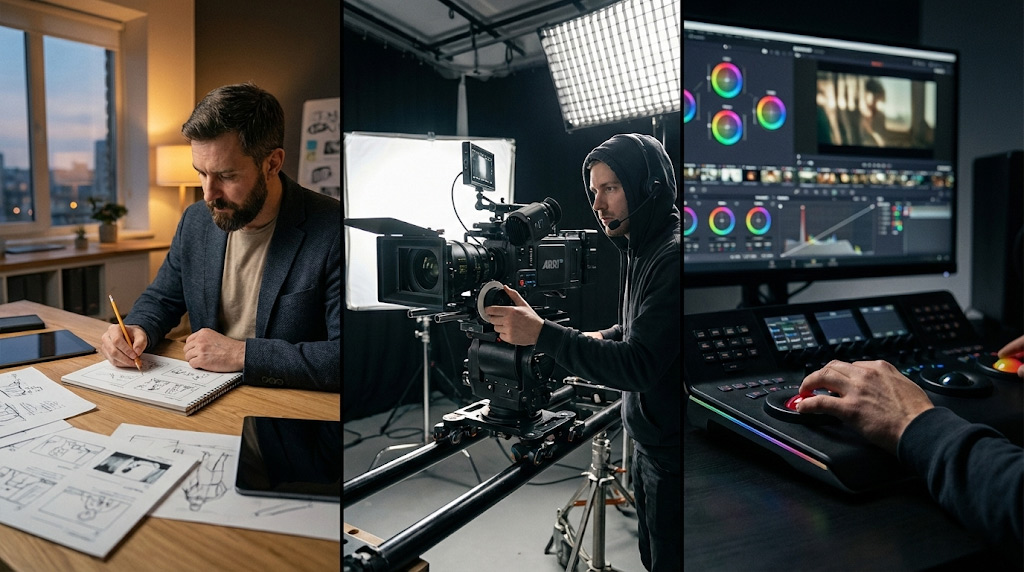
In the fourth quarter of every fiscal year, marketing departments across Toronto and North America face a familiar scenario. The budget remains in the “use it or lose it” column, and the directive comes down to producing a high-impact corporate asset before the fiscal year closes. The instinct is to rush into production to secure the spend.
However, treating video production for corporate environments as a sprint rather than a strategic operation often results in a negative return on investment (ROI). When timelines are compressed, the focus shifts from business objectives to logistical survival.
The result is a video that may look technically adequate but fails to deliver on sales enablement, brand positioning, or internal alignment. For enterprise leaders, the cost of a rushed production isn’t just the invoice amount; it is the opportunity cost of creating a single-use asset rather than a scalable content library.
A strategic timeline allows for the capture of footage that serves multiple departments for years. A rushed timeline produces a standalone video that becomes obsolete within months. This article outlines the realistic stages of production and the mathematical reality of why planning yields a significantly lower cost-per-asset.
Why Video Production Matters for Enterprise Teams
To understand why timelines are critical, we must first clarify why video production is important in a B2B context. In complex industries like manufacturing and finance, video is rarely just about “brand awareness.” It is an operational tool designed to shorten sales cycles and unify stakeholder communication.
For a manufacturing firm, video demonstrates scale and safety protocols to investors without requiring a site visit. For financial institutions, it simplifies complex regulatory updates for internal teams or explains nuanced investment products to clients.
When executed correctly, video acts as a force multiplier for your senior leadership and sales teams. It delivers a perfect, consistent pitch or explanation every time it is played. Rushing this process risks codifying an imperfect message that requires correction later, doubling the eventual cost.
What Does “Video Production” Actually Mean?
There is often a misconception among non-technical executives regarding what does video production mean. It is frequently viewed simply as the days spent filming (production) and the days spent cutting (editing). In an enterprise setting, this view is dangerously incomplete.
True enterprise production is a supply chain management process. It involves legal compliance, safety clearances, script approvals, logistical coordination, and asset management. The filming itself typically represents less than 15% of the total project timeline.
The bulk of the work lies in the strategy (ensuring the video solves a business problem) and the post-production (ensuring the final output meets brand and legal standards). Ignoring the administrative and strategic phases is the primary cause of project overruns and scope creep.
The 6 Stages of Enterprise Video Production
To plan a 2026 budget effectively, leaders must understand the standard lifecycle of a project. Below are the industry-standard phases for what are the stages of video production.
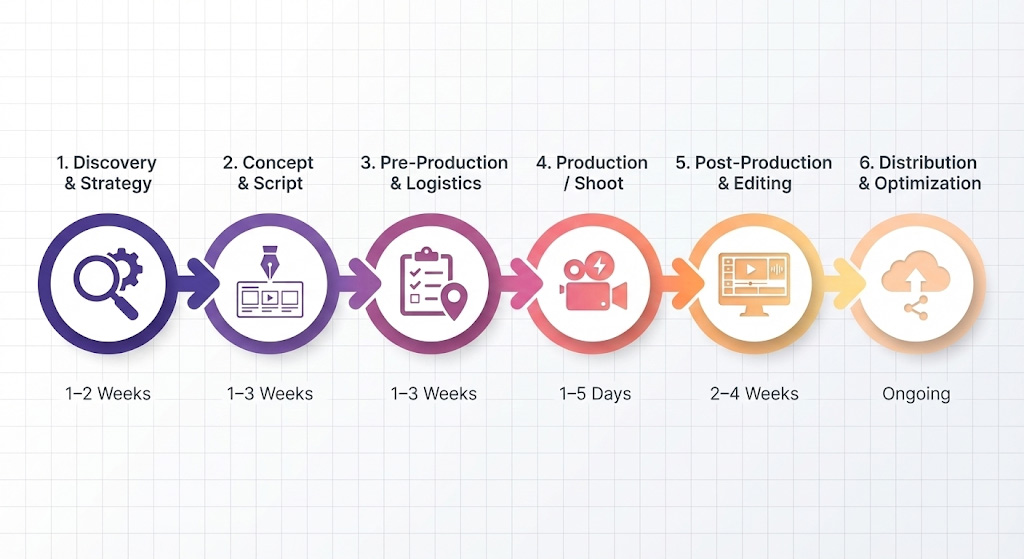
1. Discovery & Strategy (1–2 Weeks)
This phase defines the business objective. We identify the target audience, the distribution channels, and the core key performance indicators (KPIs). For B2B video marketing, this is where we determine if the asset is for lead generation, client retention, or internal training.
2. Concept & Script Development (1–3 Weeks)
This phase includes writing, storyboarding, and—crucially—internal approvals. In large organizations, the script often requires sign-off from marketing, legal, and subject matter experts (SMEs). Rushing this stage often leads to reshoots later.
3. Pre-Production & Logistics (1–3 Weeks)
This involves casting, location scouting, crew scheduling, and securing safety permits. In manufacturing, this may involve scheduling around shift changes or facility shutdowns. In finance, it involves vetting locations for data privacy compliance.
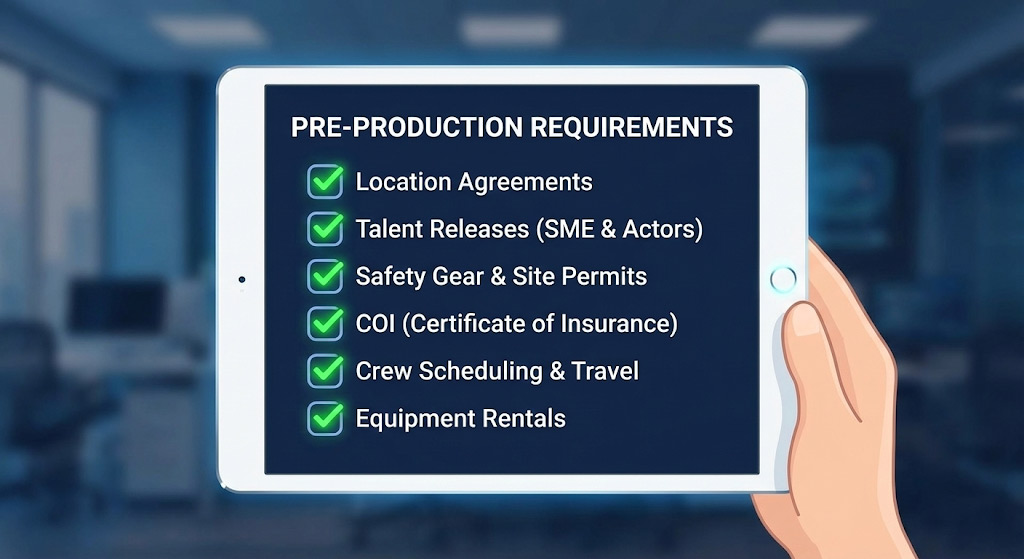
4. Production / Shoot Days (1–5 Days)
This is the execution phase. While brief, it is high-intensity. A well-planned shoot day maximizes the ROI by capturing “b-roll” (supplementary footage) that can be used for future projects. Rushed shoots rarely capture this extra value.
5. Post-Production & Editing (2–4 Weeks)
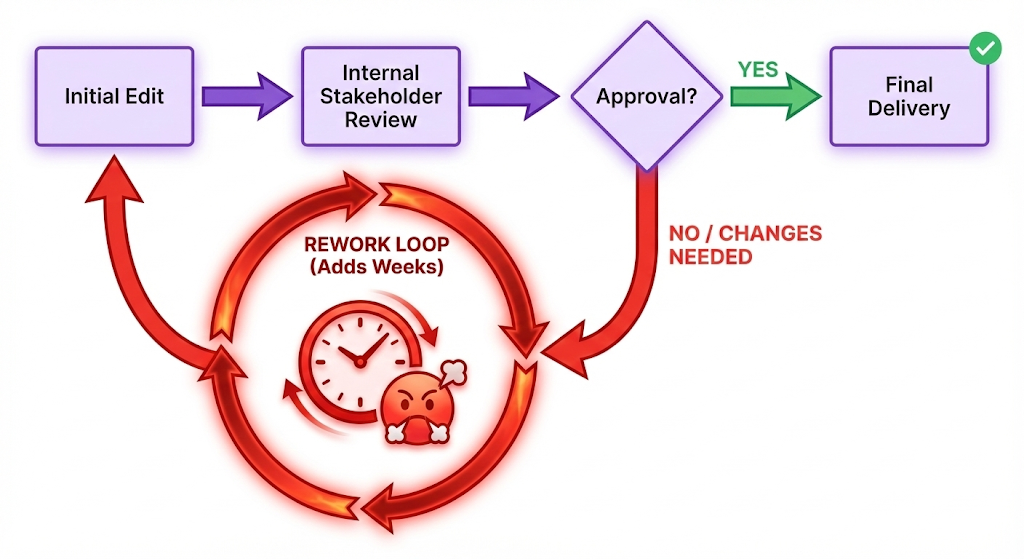
Video production and editing are inextricably linked. This phase includes the rough cut, fine cut, colour grading, sound design, and motion graphics. It also includes the feedback loops. Standard enterprise contracts typically allow for two rounds of revisions.
6. Distribution & Optimization (Ongoing)
The file delivery is not the end. The video must be uploaded, captioned, formatted for different social platforms, and integrated into marketing automation platforms.
The Hidden Cost of Rushing
When a timeline is compressed, specific compromises are made that degrade value. These costs are rarely line items on an invoice but appear as inefficiencies downstream.
Weak Strategy & Messaging
If the Discovery phase is skipped, the video may answer the wrong question. We frequently see companies produce high-gloss videos that look expensive but fail to address the specific pain points of their current buyer persona. This results in low engagement metrics.
Inability to Repurpose
A strategic shoot schedule includes time to capture assets for B2B video marketing strategy across LinkedIn, email, and sales decks. A rushed shoot focuses only on the primary script. You walk away with one video instead of a library of twenty assets.
The “Fix it in Post” Fallacy
Rushing pre-production often leads to errors on set, such as poor audio environments or incorrect safety gear being worn by employees. Fixing these issues in post-production is time-consuming and expensive. It is significantly cheaper to plan correctly than to digitally repair mistakes.
Industry Timeline Comparisons
Different industries face unique friction points that influence timelines. Below are typical ranges observed in the Toronto market and beyond.
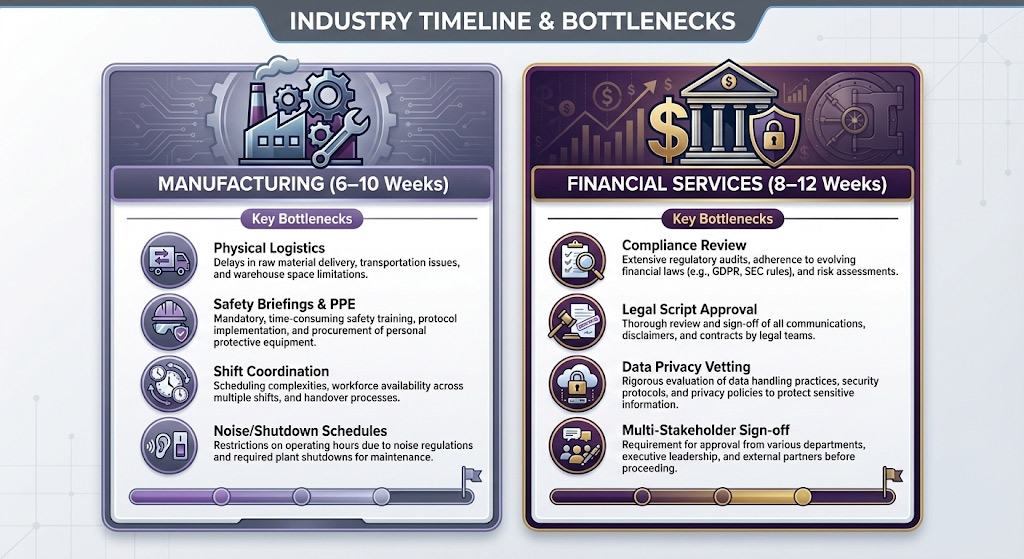
Manufacturing Video Production (6–10 Weeks)
Manufacturing video production is dictated by physical logistics. Filming on a plant floor requires safety briefings, PPE checks, and coordination with shift managers to ensure production does not halt operations. Noise levels often require specialized audio equipment or scheduled downtime, which extends the pre-production phase.
Financial Services Video Production (8–12 Weeks)
Financial services video production is dictated by compliance. The actual filming is often straightforward, involving interviews in controlled office environments. However, the script approval and final edit review often involve legal teams to ensure no regulatory lines are crossed. These review cycles can take 2–4 weeks alone.
Corporate Brand Video (6–8 Weeks)
General corporate overviews are slightly faster but still depend heavily on executive availability. Scheduling C-suite interviews is often the primary bottleneck in these productions, requiring lead times of several weeks.
When Faster Timelines Are Actually Completely Reasonable
Not every video requires a two-month runway. There are scenarios where speed is appropriate and manageable.
- Internal CEO Updates: Simple “talking head” videos intended for internal distribution often require minimal editing and legal review.
- Event Recaps: Videos capturing a conference or trade show are usually turned around in days to maintain relevance.
- Social Media Shorts: Low-fidelity content shot on mobile devices for immediate social engagement does not require enterprise production workflows.
The danger lies in applying the timeline of a social media short to a strategic brand initiative.
The Real Math Behind 10x Opportunity Loss
To quantify the cost of rushing, let us look at two hypothetical scenarios for a B2B company allocating a $30,000 budget.
Scenario A: The Rushed Project (4 Weeks)
The company demands a hero video in four weeks. The agency skips the strategy phase and rushes pre-production.
- Result: One 2-minute corporate overview video.
- Outcome: The video is used on the website home page. It cannot be cut down for social media because the framing was not planned for mobile.
- Cost Per Asset: $30,000.
Scenario B: The Strategic Project (10 Weeks)
The company allows for proper discovery and pre-production. The agency identifies that the sales team needs objection-handling assets.
- Plan: During the same shoot days used in Scenario A, the crew interviews three subject matter experts and captures specific b-roll for social media.
- Result: One 2-minute hero video, five 30-second social cuts, and three FAQ videos for the sales team.
- Total Assets: 9 high-quality videos.
- Cost Per Asset: ~$3,300.
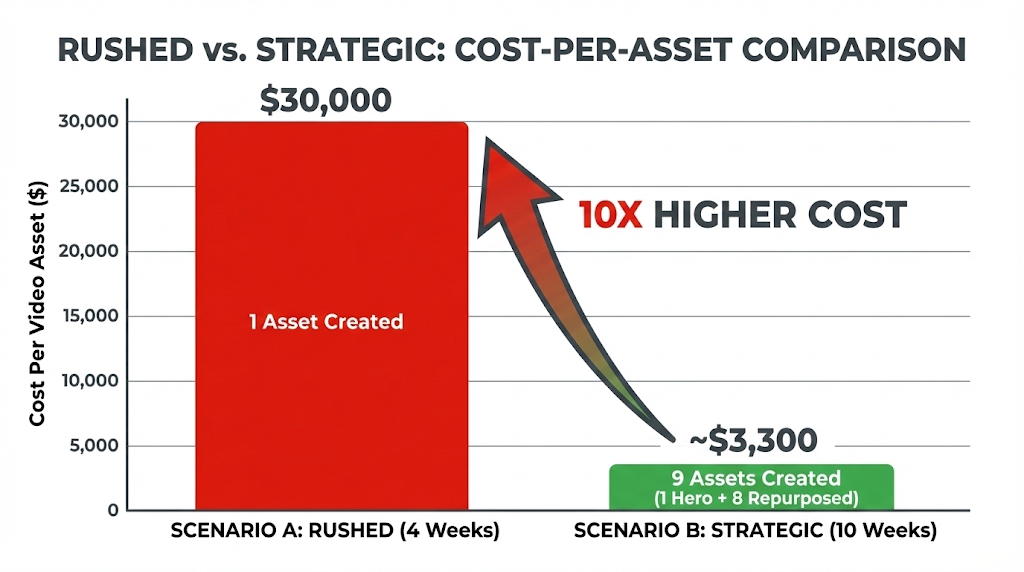
In Scenario B, the company achieves a 10x return on the content volume for the same production spend. The only difference is the timeline allowed for planning.
How B2B Teams Can Protect Their Video Investment
To ensure your 2026 video budget yields Scenario B results, follow these operational steps.
1. Involve Compliance Early
In finance and healthcare, show the legal team the script before a camera is turned on. This prevents expensive reshoots or edits later.
2. Batch Your Production
Do not shoot one video at a time. Plan a “production week” to capture executive interviews, customer testimonials, and b-roll all at once. This maximizes the efficiency of the crew and equipment rental.
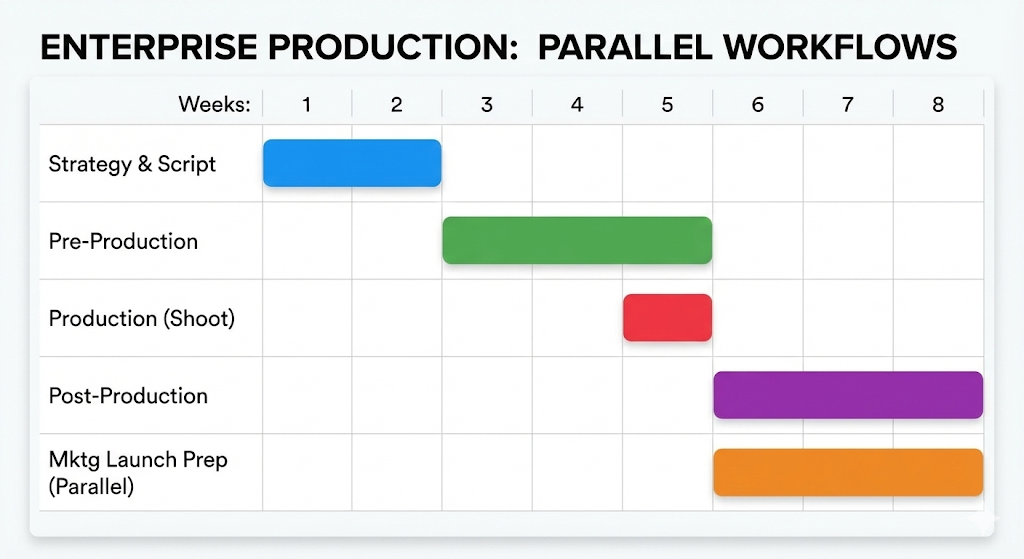
3. Parallelize Workflows
While the video is in the editing stage, your marketing team should be preparing the landing pages, email copy, and distribution strategy. Do not wait for the final file to begin the launch plan.
4. Define the Deliverables List Upfront
Contractually agree on the number of social cut-downs and aspect ratios (9:16 vs 16:9) before the shoot. This ensures the camera operators frame the shots to accommodate both formats.
5. Standardize Your Review Process
Designate one “consolidator” on your team to gather feedback from all stakeholders. Conflicting feedback from different VPs is the leading cause of post-production overages.
FAQ: Common Production Questions
How does video production support B2B marketing? B2B video marketing supports the funnel by building trust at scale. It educates prospects at the top of the funnel and provides detailed product validation at the bottom of the funnel, effectively cloning your best sales reps.
Is it hard to get into video production workflows if we are new to it? While is it hard to get into video production processes initially, partnering with an agency that understands enterprise workflows simplifies the transition. The agency manages the complexity, allowing your team to focus on messaging.
What is the difference between production and post-production? Production refers to the physical capture of audio and video on location. Post-production refers to the editing, sound mixing, colour correction, and addition of graphics that occur after filming is complete.
Conclusion
Video is no longer a “nice to have” experimental medium; it is a primary channel for corporate communication and B2B sales. Treating it with the same rigorous planning as a product launch or an IT implementation ensures that the budget is spent on assets that serve the business long-term.
Rushing a production may solve a short-term budget utilization problem, but it creates a long-term content deficit. By respecting the 6-to-12-week timeline typical of enterprise projects, organizations can secure a library of content that drives ROI well into the next fiscal year.
If you are planning your 2026 content calendar, now is the time to begin the conversation. Contact Shot One Studio today to discuss a production strategy that prioritizes business impact over speed.